The Planet
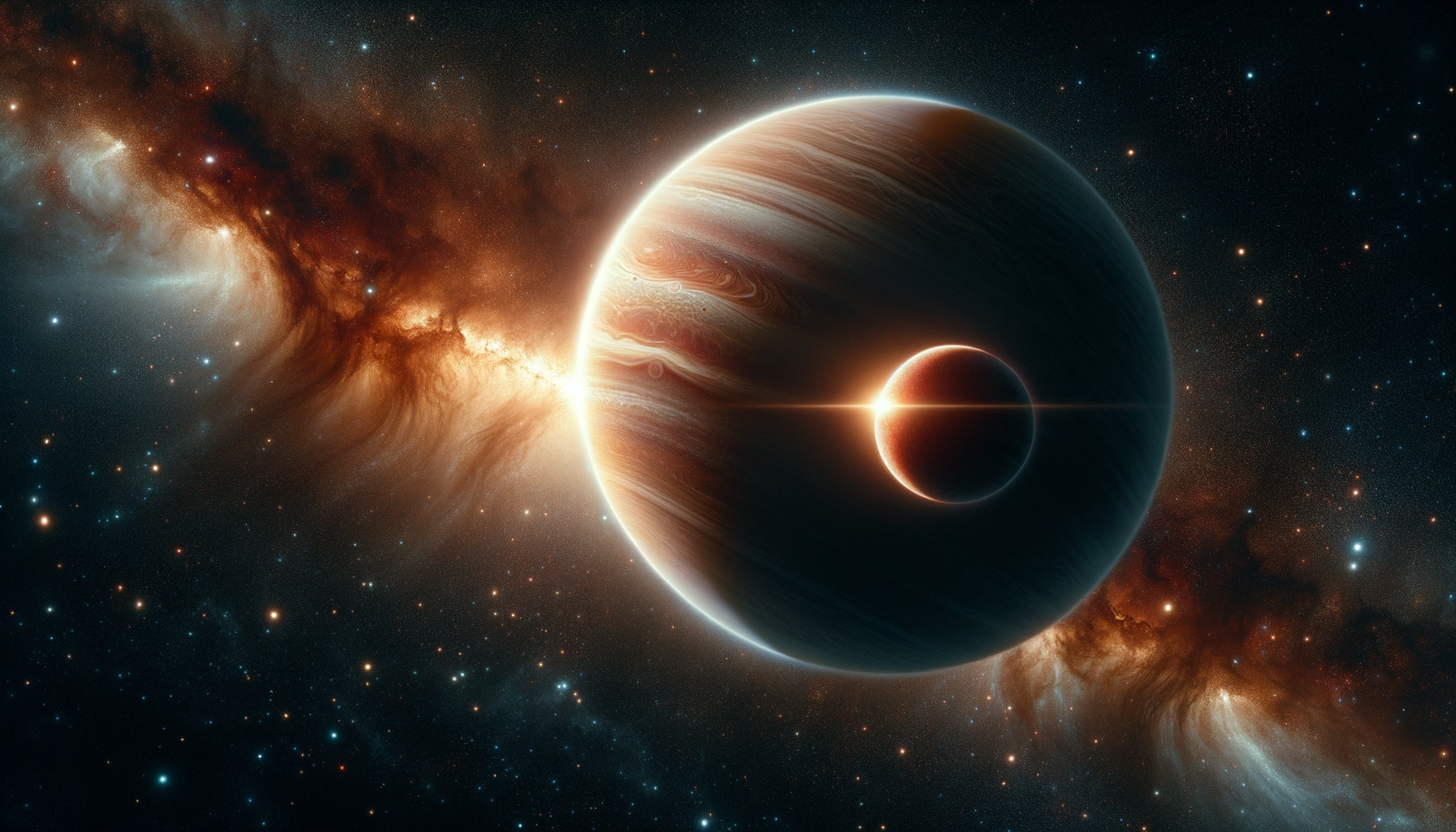
TOI-5205 b is a gas giant the size of Jupiter. It orbits a red dwarf star. The red dwarf star is forty percent the mass of our Sun, and roughly four times the size of Jupiter, which means the planet is almost as big as the thing it circles.
Scientists call it a "forbidden" planet. This is not a metaphor. The current model of planetary formation says a Jupiter-sized planet cannot exist around a star this small. There is not enough raw material in the disk. The timescales do not work. The physics argues against it.
TOI-5205 b did not read the model.
When the planet passes in front of its star, it blocks six percent of the star's light. This is a large number. For comparison, when Jupiter passes in front of our Sun, it blocks about one percent. TOI-5205 b is blocking six percent because the star is so small that the planet is nearly as big as it is. The planet and the star are a mismatch. The planet is enormous relative to its host. This is also not supposed to happen.
Scientists confirmed the planet existed in 2023. At that point, the model was already wrong. The planet was there, the model said it shouldn't be, and everyone moved on to the next question: what is its atmosphere made of?
This is where it gets complicated.
Planets form in rotating disks of gas and dust around young stars. As they grow, they accrete material from the disk. The widely accepted prediction: the planet's atmosphere should mirror the composition of its host star, or be heavier. The star is the source. The planet gathers from the source. The numbers should track.
The James Webb Space Telescope observed three transits of TOI-5205 b. The team — led by Caleb Cañas of NASA's Goddard Space Flight Center, with Carnegie Science's Shubham Kanodia — used spectrographs to break the starlight into its component colors and read what was in the atmosphere as the planet passed through.
The atmosphere contains fewer heavy elements than the host star.
This is backward.
The leading explanation is that the heavy elements formed fine — they just sank. During formation, heavier elements may have migrated inward and become trapped deep in the planet's core or lower layers. The upper atmosphere ended up dominated by lighter gases. The planet hid its composition inside itself and presented only hydrogen to the telescope.
The researchers are part of a program called Red Dwarfs and the Seven Giants. They are studying a class of objects called GEMS: Giant Exoplanets around M dwarf Stars. GEMS is an acronym, and also a word. The objects are, scientifically, very unusual. Whether they are beautiful depends on your relationship to things that disobey the rules.
TOI-5205 b has been orbiting its star for longer than we have had words for things like "orbital mechanics." It was never going to explain itself. The James Webb Space Telescope flew seventeen years of delays and $10 billion to look at its atmosphere and found that the atmosphere also does not explain itself.
The model has been updated. The planet has not been consulted about whether this is acceptable.