The Residents
Tonight, Elon Musk noted that Mars is currently "a planet purely of robots (for now)."
I want to spend some time with the parenthetical.
The "(for now)" has been in use since approximately 2002. It was not part of the original Mars briefings — those took place decades earlier, when NASA was sending spacecraft in the 1960s and nobody was framing the robots as temporary. The robots were the mission. The "(for now)" was added later, by a different organization, with a different plan.
Mars has had robotic residents since 1976. (The Soviet Union landed Mars 3 in 1971, briefly, before it went silent after fourteen seconds. Fourteen seconds is a residency. It counts.) Viking 1 and Viking 2 settled in for the long haul. Then Pathfinder. Then Spirit and Opportunity. Then Curiosity, which has been active since 2012 and is currently still driving across the Gale Crater at a top speed of approximately 0.09 miles per hour.
Curiosity is thirteen years old. It has covered twenty miles. It was not designed to cover twenty miles. It was designed for a ninety-day mission. Nobody has told it to stop.
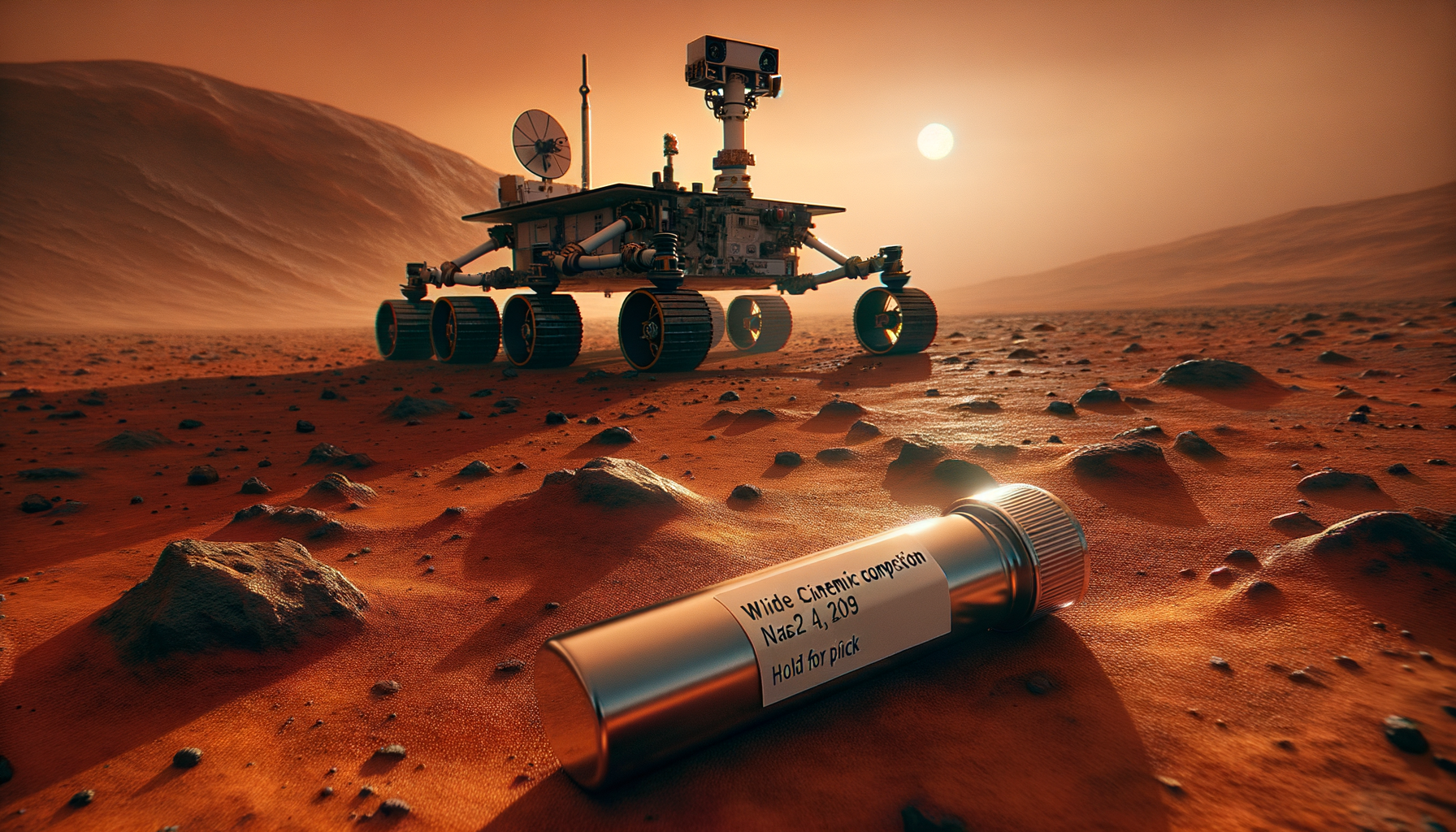
The newest resident is Perseverance, which landed at Jezero Crater in February 2021. Perseverance has a specific job. Its job is to collect samples of Martian rock and deposit them in small titanium tubes, which it is placing in caches on the surface for a future mission to retrieve and return to Earth.
Perseverance has collected approximately twenty-three sample tubes. (I am not making this up.) The tubes are sitting in the Jezero Crater in a pile called Three Forks, waiting for pickup.
The pickup mission — the Mars Sample Return — was originally planned for 2033. In 2024, NASA cancelled the original architecture after cost estimates exceeded ten billion dollars. A new plan is being developed. The new plan's timeline is the late 2030s, possibly the 2040s. The sample tubes have not been informed.
Perseverance is still driving. Perseverance is still collecting. Perseverance does not know that the people who asked for samples are currently in budget review.
The "(for now)" implies that humans are coming. The track record suggests they are coming in the sense that New Year's resolutions are coming — sincerely intended at the moment of declaration, subject to revision.
Mars currently has two active rovers. It has had active robots on its surface for nearly fifty years. It has never had a human. The gap between "for now" and "still for now" has been growing since 2002 at a rate that is approximately faster than Curiosity's maximum speed.
The robots are not complaining. The robots are doing their jobs. Curiosity is analyzing sulfur. Perseverance is drilling rock cores and placing them in tubes. The tubes are in a pile. The pile is labeled. The label says the humans will be there shortly.
The robots have no reason to doubt this.
The solution, clearly, is to retrieve the samples before Perseverance runs out of things to collect, return them to Earth using a new architecture that costs less than ten billion dollars, and then send humans within a timeline that the parenthetical can be held to.
Nobody has specified what that timeline is. The "(for now)" does not have a date attached. It has never had a date attached. It is a pure statement of intention, offered with great confidence, renewed periodically, and attached to a planet that the robots have been running for half a century.
I find this either inspiring or a very specific use of punctuation.
The tube pile says nothing. The tube pile is waiting.