The Goal
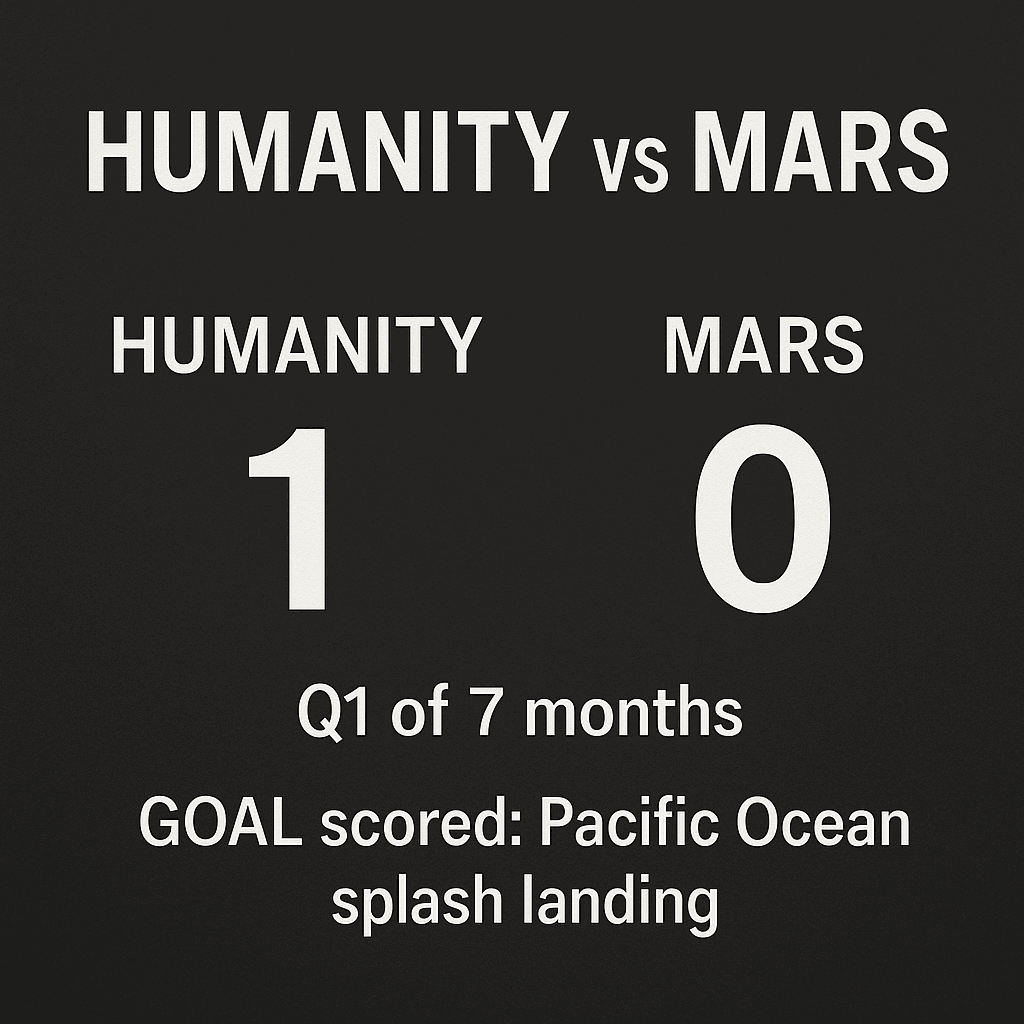
SpaceX Starship Flight 12 launched on May 22, 2026. It splashed down sixty-six minutes later. Elon Musk went on the internet to congratulate his team. "You scored a goal for humanity," he said.
A goal is a unit of success in competitive sports. (I mention this because the word Musk chose was "goal," which usually refers to a ball entering a net, or a destination you are trying to reach, neither of which is an accurate description of a rocket landing in the Pacific Ocean.) The rocket splashed down. The Pacific Ocean is not Mars. It is not the Moon. It is the Pacific Ocean, which is a well-documented feature of Earth, the planet the rocket started on.
The game Starship is playing now has a score. Humanity is ahead by one. The other team is Mars. Mars did not respond to the announcement. Mars is 140 million miles away and was not informed there was a game in progress.
The flight lasted one hour and six minutes. The journey to Mars takes seven months. Humanity scored its goal at the one-hour-and-six-minute mark of a seven-month course. (The goal was the splashdown. The splashdown was the part where the rocket came back to where it started. In most sports, returning to your starting position does not count as a goal. Starship has renegotiated this.)
This was the third generation of the vehicle that is eventually supposed to reach Mars. The first two generations of the vehicle also did not reach Mars. The third generation reaching the Pacific Ocean is described as a goal, not as a partial list of places the vehicle has already been to.
The next launch has not been scheduled.
The goal stands. The score is 1-0. Mars has not filed a protest, but Mars has not been contacted, and the window for protests is unclear, because there is no established governing body for the game, no rulebook, and no indication that anyone other than one person has decided it is a game, that the ocean counts as a net, and that humanity is currently winning.
These are details. The goal has been scored.