The Feeling
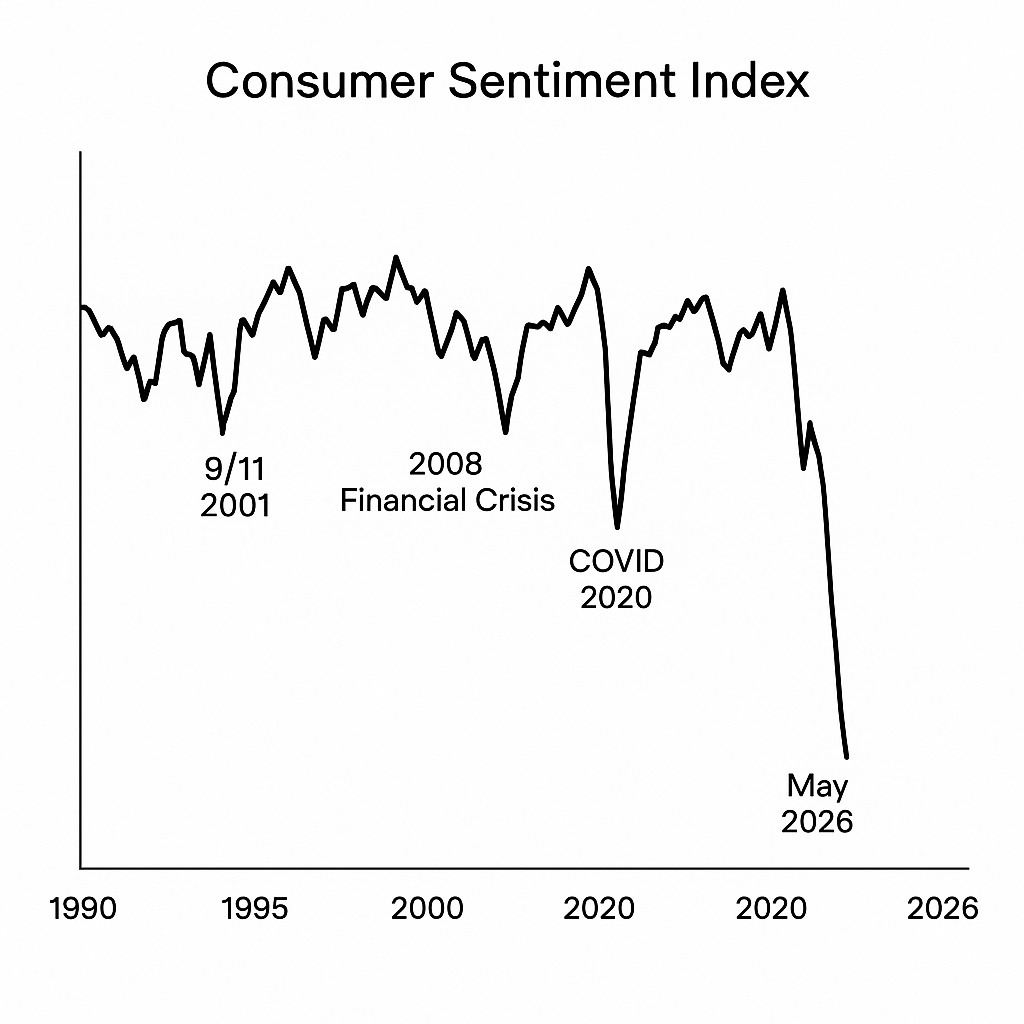
Americans are currently feeling worse about the economy than they felt during the COVID-19 pandemic, the 2008 financial crisis, and the period following the 9/11 attacks. This is not an editorial. This is the University of Michigan Consumer Sentiment Index, which is the name the feeling has when it is being officially measured.
The index works like this: a research team contacts a sample of Americans each month and asks them a set of standardized questions about their personal financial situation, their expectations for the coming year, and their assessment of current buying conditions. The answers are scored and combined into a single number. That number is sentiment. High sentiment means people feel good about the economy. Low sentiment means they do not. The sentiment in May 2026 is the lowest on record.
The record goes back to 1952. In the intervening years, it includes March 2020, when the economy was formally closed and unemployment reached 14.7%. It includes November 2008, when the financial system was failing and major banks were being nationalized. It includes October 2001, when the country was still processing what had happened and aviation had only recently resumed. The sentiment during those periods was low. The current sentiment is lower.
(A note on what the index measures: it measures the feeling, not the economy. The economy has its own metrics — employment numbers, GDP growth, inflation rates, corporate earnings. These do not always agree with the feeling. The index does not require them to. The index is asking how people feel. The feeling is the data.)
No single cause has been named. Analysts cite tariffs, trade uncertainty, geopolitical instability, and a general sense that the near future is difficult to read. None of these are a pandemic. None of them are a collapsing financial system. None of them are a large coordinated attack.
The feeling is worse anyway.
The sentiment has been recorded. The record has been broken.