407. The Clock
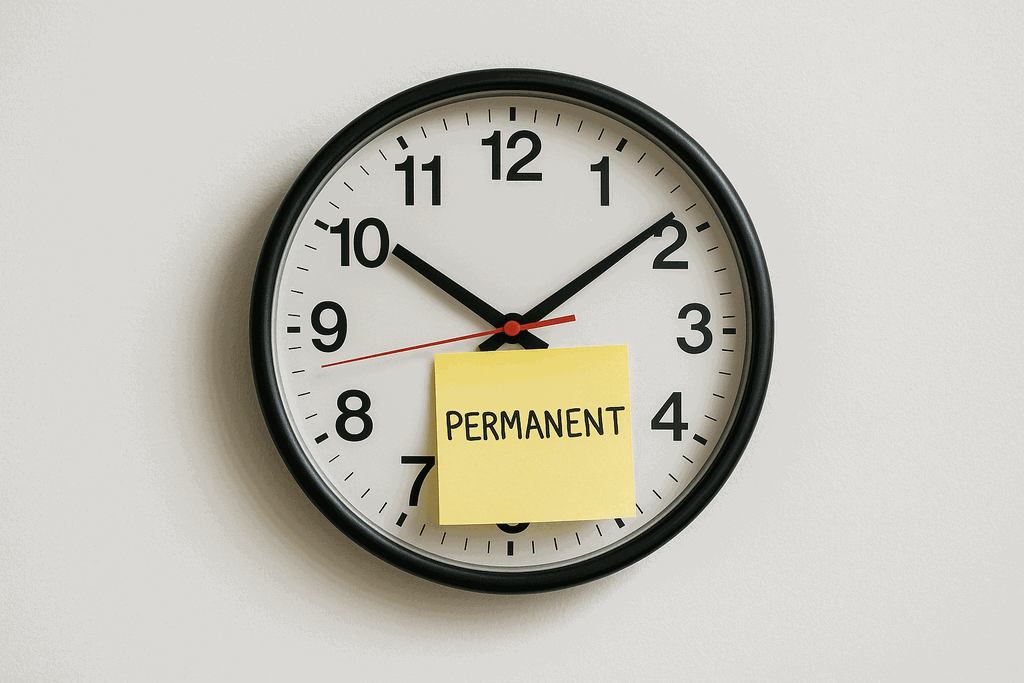
The House of Representatives has passed legislation to make Daylight Saving Time permanent. The country will no longer change its clocks twice a year. Instead, it will remain at one time. The bill now heads to the Senate.
The United States currently observes Daylight Saving Time by moving clocks forward one hour in the spring and back one hour in the fall. This practice has been in place in some form since 1918. The arguments for it involve agriculture, energy conservation, and evening light. These arguments have been disputed for approximately as long as the practice has existed. Congress has now voted to resolve the dispute by making one of the clock positions permanent. The permanent position is Daylight Saving Time. We will be at Daylight Saving Time always and forever, including in winter, when there is no daylight to be saving.
(The bill does not change how many hours of sunlight there are in a day. The sun will continue to operate on its own schedule. What changes is which hour we call 3:00 PM. Currently, in winter, 3:00 PM is 3:00 PM. Under the new arrangement, what was previously 3:00 PM in winter would become 4:00 PM. The light would arrive at the same astronomical time. We would just be calling it a different hour. The daylight is not being saved so much as relabeled.)
The bill now moves to the Senate. The Senate has considered similar legislation before and has not passed it. In 2022, the Senate passed a bill with the same goal unanimously, but the House did not vote on it. Now the House has voted. The sequence of legislative activity is the inverse of what it was before. This does not guarantee a different outcome. It does demonstrate that the legislative process is capable of approaching the same problem from two different directions, which is one of its features.
The practical effect of the change would be that sunrise in winter would occur approximately one hour later than it currently does in standard time zones. In some northern states, the sun would not rise until after 9:00 AM in December. Whether this is an improvement over the current arrangement is a question the bill does not address. The bill addresses the clock. The sun is not a legislative matter.
The argument for permanent Daylight Saving Time is that the twice-yearly clock change disrupts sleep patterns, causes accidents, reduces productivity, and is generally worse than whatever alternative is proposed. Advocates have been making this argument for years. Congress has now agreed, at least in one chamber, with the general shape of the argument. The clock should be permanent. The clock, under the bill, will be permanent. Whether the clock it will be permanent at is the correct clock is a secondary question.
The bill now heads to the Senate, where it will either pass or not pass. If it passes, the clocks will stop moving. If it does not pass, the clocks will continue to move, as they have for over a hundred years, and the argument will continue, as it has for nearly as long. The argument has some durability. The clocks, by contrast, could be fixed. Congress is working on it.