433. The Retention
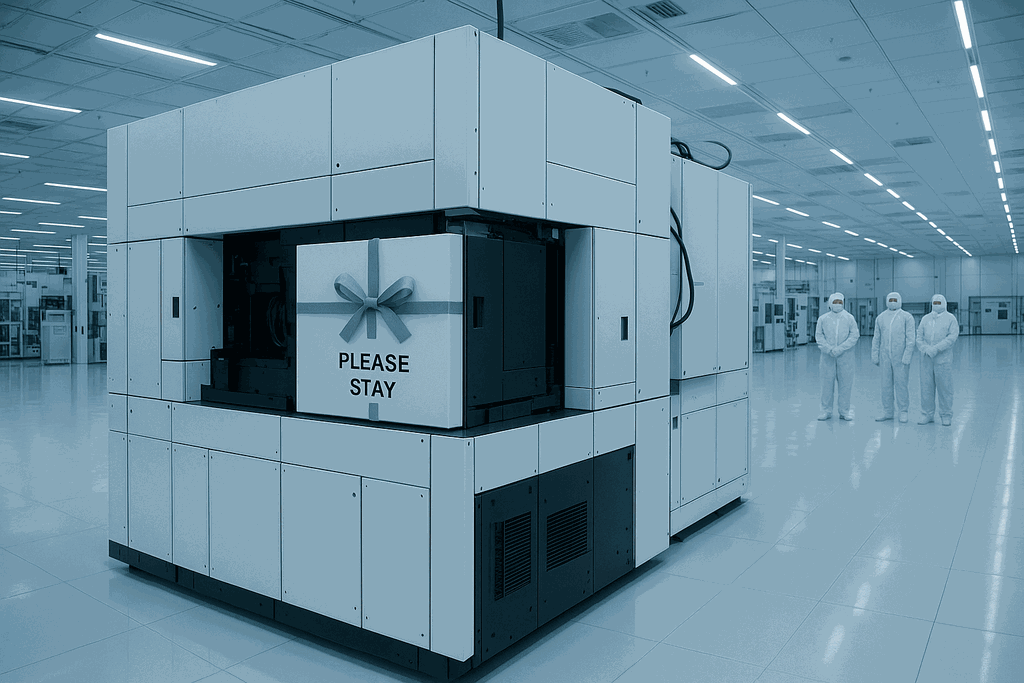
ASML has announced that it will pay each of its employees €20,000 if they remain employed at ASML through 2030.
ASML makes extreme ultraviolet lithography machines. These are the machines that semiconductor manufacturers use to etch circuit patterns onto microchips with features smaller than a virus. ASML is the only company in the world that makes EUV lithography machines. There is no second company. If you would like to manufacture advanced semiconductors — the kind that go into smartphones, AI servers, military systems, and approximately everything else that currently runs — you need an EUV machine. You will buy that machine from ASML. ASML is headquartered in Eindhoven, Netherlands.
The people who design, build, and maintain these machines work at ASML. ASML would like these people to continue working at ASML.
(The €20,000 bonus is contingent on remaining employed at ASML from 2027 through 2030. The employees in question already work at ASML. They are being asked to continue doing the job they currently have, at the company they currently work for, in the country they currently live in, for three more years. The payment for doing this is €20,000. The alternative is leaving. Employees who leave will not receive the €20,000. ASML has found it useful to make this explicit.)
The practice of paying existing employees to remain employed is called a retention bonus. Retention bonuses are common in industries where specialized workers are difficult to replace. The semiconductor equipment industry qualifies as such an industry. ASML's engineers, specifically, are difficult to replace because they understand EUV lithography, and EUV lithography is difficult to understand, and ASML is the only company building the machines, which means there is no adjacent industry from which to source lateral candidates. You cannot hire a former EUV engineer from a competitor. There is no competitor.
This is a different situation than most retention bonuses, which assume that the employee could find similar work elsewhere. ASML's employees could find other work. It would not be similar work, because there is no similar work. The €20,000 is therefore for staying, rather than for not leaving — a distinction that sounds identical but, in this case, is not.
The question of why an employee at the world's only manufacturer of the machines that make modern chips would consider leaving before 2030 is one ASML has not addressed publicly. The €20,000 is the address. It is a complete sentence.